
TWU’s Contribution to the Nation: Luella F. McWhirter — The Power of Women’s Civic Leadership
July 20, 2026 2026-07-20 11:19TWU’s Contribution to the Nation: Luella F. McWhirter — The Power of Women’s Civic Leadership
TWU’s Contribution to the Nation: Luella F. McWhirter — The Power of Women’s Civic Leadership
Long before women could vote nationwide, hold public offices, or were recognized in civic life, Luella Frances Smith McWhirter was already helping shape the future of her community.
She was a graduate of East Tennessee Wesleyan University in Athens, a predecessor of today’s Tennessee Wesleyan University. McWhirter carried her education far beyond the classroom. Her life would become a testament to the growing influence of women in American public and civic life at the turn of the twentieth century.
Born in 1859 in Perrysville, Indiana, McWhirter was raised in a Methodist household that emphasized faith and service. Those values followed her to East Tennessee Wesleyan, where she received an education, something that was still uncommon for women of her time. While in Athens, she met Felix T. McWhirter, then serving as mayor of the city. The two married in 1878 and eventually settled in Indiana, where their lives would intersect with education and civic leadership.
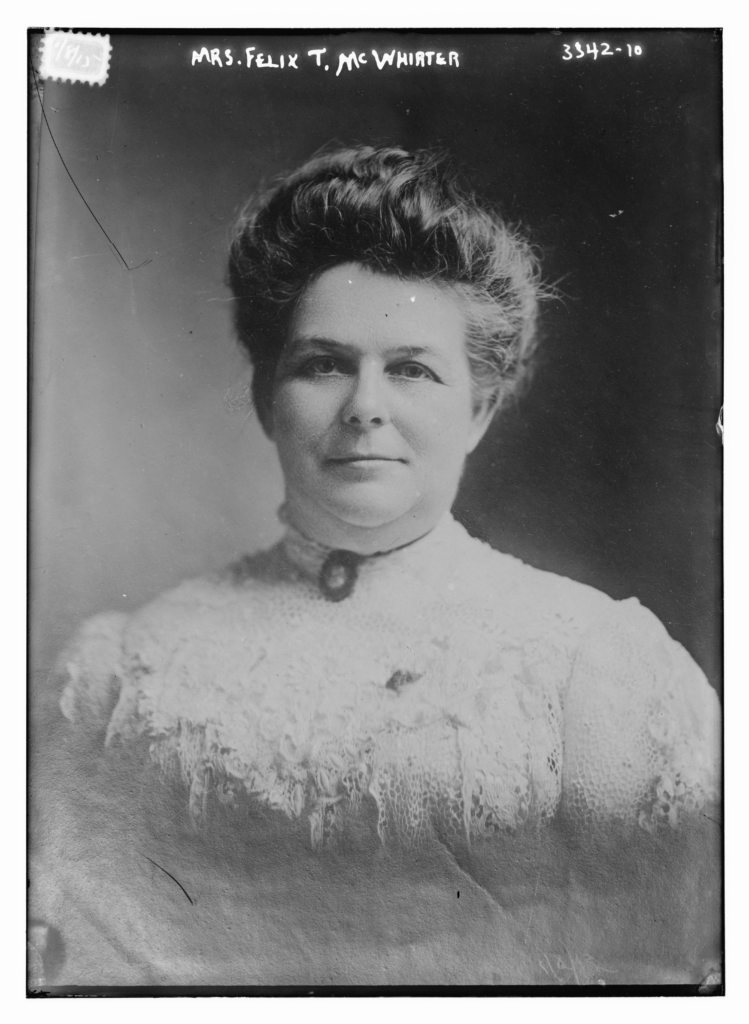
In Indianapolis, McWhirter became part of a growing movement of women who were redefining their role in society, not through elected office but through organization, advocacy, and ultimately action. Women’s clubs, church groups, and reform organizations became powerful platforms for influence, and McWhirter emerged as a truly effective leader. She served as president of the Indiana State Woman’s Christian Temperance Union, one of the most influential women’s organizations of the time. Through the WCTU, she worked to advance public morality, education, family welfare, and legislative reform. As editor of the organization’s publication, The Message, she also helped shape public opinion and connect women across the state in a shared mission of reform.
Her leadership extended into the movement for women’s suffrage. As vice president of the Woman’s Franchise League of Indiana, McWhirter stood among those advocating for a fundamental expansion of American democracy. She framed her arguments around moral influence and the need for women’s voices in addressing the challenges of modern society.
In 1893, McWhirter and fellow Methodist women helped establish the Door of Hope in Indianapolis, a shelter serving women in crisis. many of whom arrived alone at Union Station with nowhere else to go. In its first year, the shelter provided refuge to more than one hundred women.
This love and devotion to others was a reflection of how McWhirter understood leadership not only as something expressed in speeches or organizations but as something lived out in compassion to others.
McWhirter’s impact still did not stop there. She served as a director of Peoples State Bank, helping guide one of Indianapolis’s growing institutions. This was a role that women had never seen before. She was a reformer, an organizer, an editor, a philanthropist, a civic leader, and a pioneer in business. McWhirter did all of this before women had secured the right to vote nationwide. And even after that right was won, she continued her lifelong commitment to civil service.
As part of “TWU’s Contribution to the Nation,” Luella F. McWhirter represents a legacy that is both powerful and enduring. Her life reminds us that change often begins not in positions of authority but in the willingness to step forward, educate, and serve.