
TWU Honors Program Travels to Czechia for Annual Study Abroad Trip
November 24, 2026 2026-11-24 9:15TWU Honors Program Travels to Czechia for Annual Study Abroad Trip
TWU Honors Program Travels to Czechia for Annual Study Abroad Trip
This June, students from Tennessee Wesleyan University traded the classroom for the streets, castles, synagogues, museums, and universities of Central and Eastern Europe. Through a faculty-led study abroad course offered jointly by the TWU Honors Program and the Department of History, students spent more than two weeks in Czechia, Poland, and Austria studying how ideas of nationality and ethnicity have shaped the history, and the daily lives, of the region.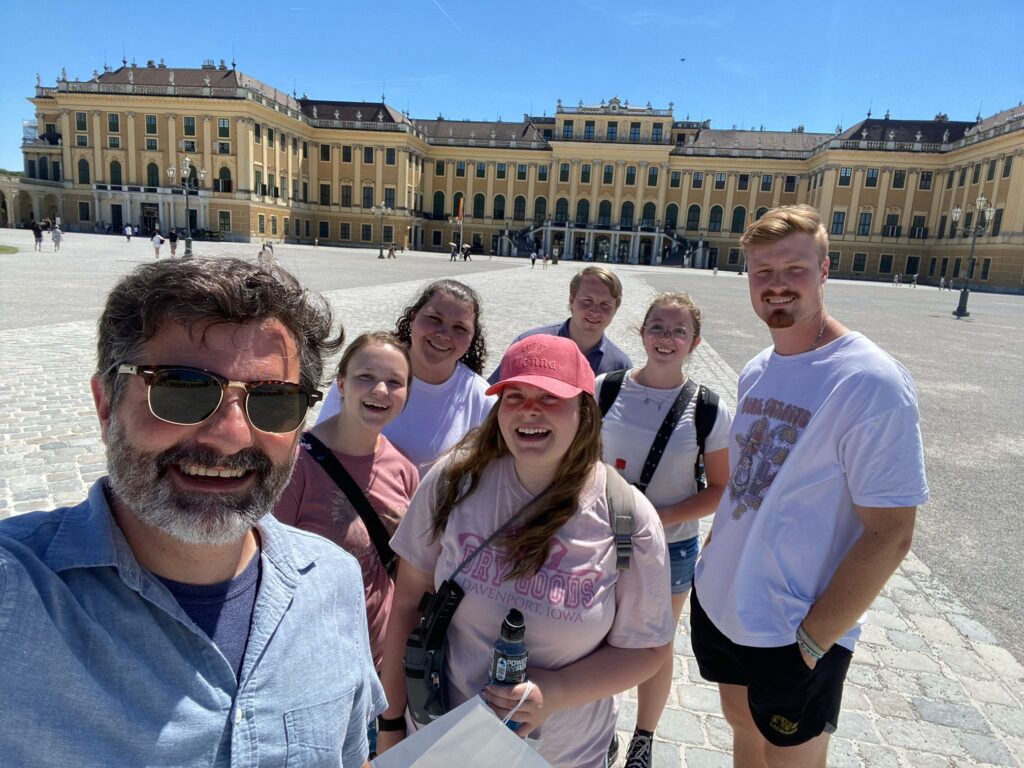
The course, History 319/Honors 390: Making Nations and Ethnicities in East and Central Europe, was designed and led by Dr. John B. Seitz, assistant professor of history. It combined a month of rigorous academic preparation with an immersive trip that ran from June 12 to June 28, 2026.
Dr. Seitz said, “The central question in this course is ‘why did some peoples get to become states and others did not?’ I hope students come away from this experience with a deeper understanding of how nations and national identities are formed, shaped, and sometimes contested over time as much by contingency and chance rather than out of some primordial notion of blood and soil. East and Central Europe offer a particularly rich setting for exploring these questions because the region’s history reveals how borders, cultures, languages, and political movements intersect (and sometimes bisect) in the making of national identity. More than simply learning about these histories in a classroom, I hope students gain an appreciation for how the past continues to shape the places and people they encounter today. Studying abroad allows them to step outside their familiar perspectives, engage directly with different cultures, and recognize the complexity of the world around them. Ultimately, I hope they return not only with a stronger historical understanding, but also with greater curiosity, empathy, and a willingness to question how they understand their own identities and the world they inhabit.”
The June mini-term began with online instruction in early June, as students worked through the major scholarship on nationalism and the region. Readings included Ernest Gellner’s Nations and Nationalism, Benedict Anderson’s Imagined Communities, Pieter Judson’s The Habsburg Empire: A New History, Kevin McDermott’s Communist Czechoslovakia, 1945–1989, and William McCagg’s A History of Habsburg Jews. Lectures moved from the question of what ethnicity and nationality actually are, to the history of them in Habsburg lands, to Jewish life and history in the region, and finally to the Second World War and the Holocaust ending in the era of Communism and its collapse. Students also kept weekly reading journals and, once abroad, daily travel journals in which they were asked to connect what they had read with what they were seeing.
 After flying from Knoxville to Prague, the group traveled by train to Olomouc, where they made their home base for ten days in the dormitories of Palacký University. Students were paired with Czech university “buddies,” attended Czech language lessons taught by esteemed Palacký faculty member, Václav Řeřicha and took day trips across the region including a walking tour of Olomouc; the castle and historic Jewish quarter of Boskovice; the Strážnice Open Air Museum; as well as the Moravian regional capital of Brno, where students visited the Moravian Museum and the Museum of Romani Culture; as well as nearby Mikulov, where they toured the castle, synagogue, and Jewish cemetery. A day trip to Český Těšín gave students the chance to stroll across the border into Poland and experience a city with two halves, a Polish and a Czech half, divided into two parts in the contested aftermath of WWI. Czech language lessons were part of the course design, not a side activity. Language, as the course emphasized, has been (and remains) deeply political in a region where it shaped who belonged to a nation and who did not.
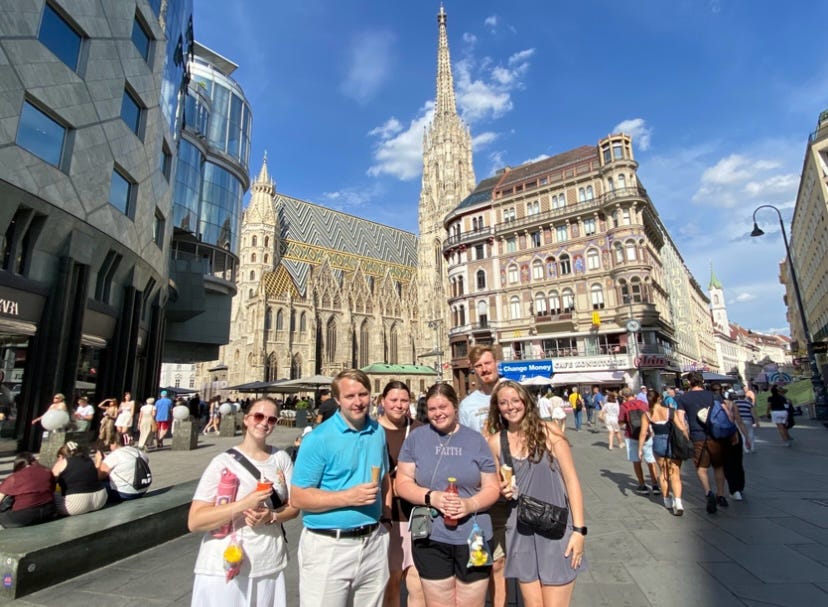
The group then widened its lens. In Kraków, Poland, students explored the Old Town and the Kazimierz district and visited Wawel Hill and Castle and visited the Cathedral, a defining feature in the construction of Polish nationality. In Vienna, they walked the Ringstrasse exploring its buildings as a construction of national identities through buildings like the library, city hall, and university. In Vienna they also toured the Hofburg Palace, and explored the gardens of Schönbrunn, putting the elite stage of the Habsburg Empire they had read about in front of them. The trip concluded in Prague with visits to the Prague Old Town and Jewish Quarter as well as a trip to nearby Terezin, a garrison town that became a ghetto for Jews during the Holocaust.
Student reflections show how much of the learning happened in the places themselves. One student wrote that studying nationalism while standing in Mikulov made the subject tangible: “it really is easier to learn and think about these questions because the space in which we were learning was closely tied to what we were learning about.”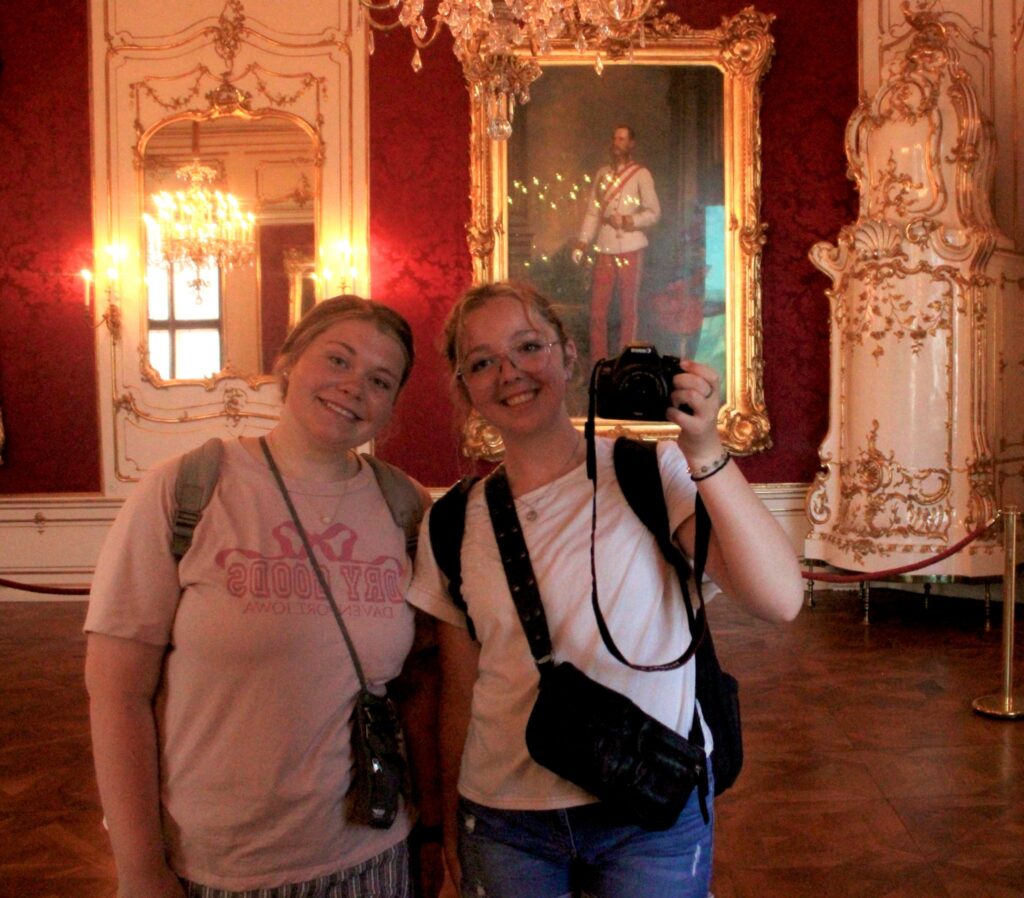
Another student said she had previously understood Jewish history almost entirely through the Holocaust. Through classroom preparation, museum visits, and the historic sites themselves, she came to see centuries of discrimination, exclusion, and persecution that came before it, and the course pushed her to ask “why certain events happened instead of being solely focused on what happened.” Others described encountering the history of the Romani people and the complex development of Central European identities for the first time.
For many participants, the lessons reached well beyond history. One student wrote that over sixteen days she had “learned more about the world and myself than I imagined possible.” Another concluded that “the best way to grow as a person is to travel and experience things you never have before.”
Students described questioning assumptions they had never examined. One said that before the course she had never thought about why the world is divided into nations and borders; afterward she kept asking why societies divide people the way they do and whether those divisions are inevitable. Another reported that, in a course designed to examine nationality, she found herself thinking of herself less as belonging to a single nation and more as “a citizen of the world.”
The trip also built empathy. A student who at first found language barriers intimidating learned that communication depended more on patience, curiosity, and shared humanity than on perfect vocabulary, concluding that “everyone is more similar than we realize.” Another said she now has a new appreciation for immigrants and multilingual people after experiencing what it is like “to have no clue what is going on.” Friendships with Palacký University students reinforced the lesson: young adults on both sides of the Atlantic, participants found, share remarkably similar hopes, worries, and ambitions.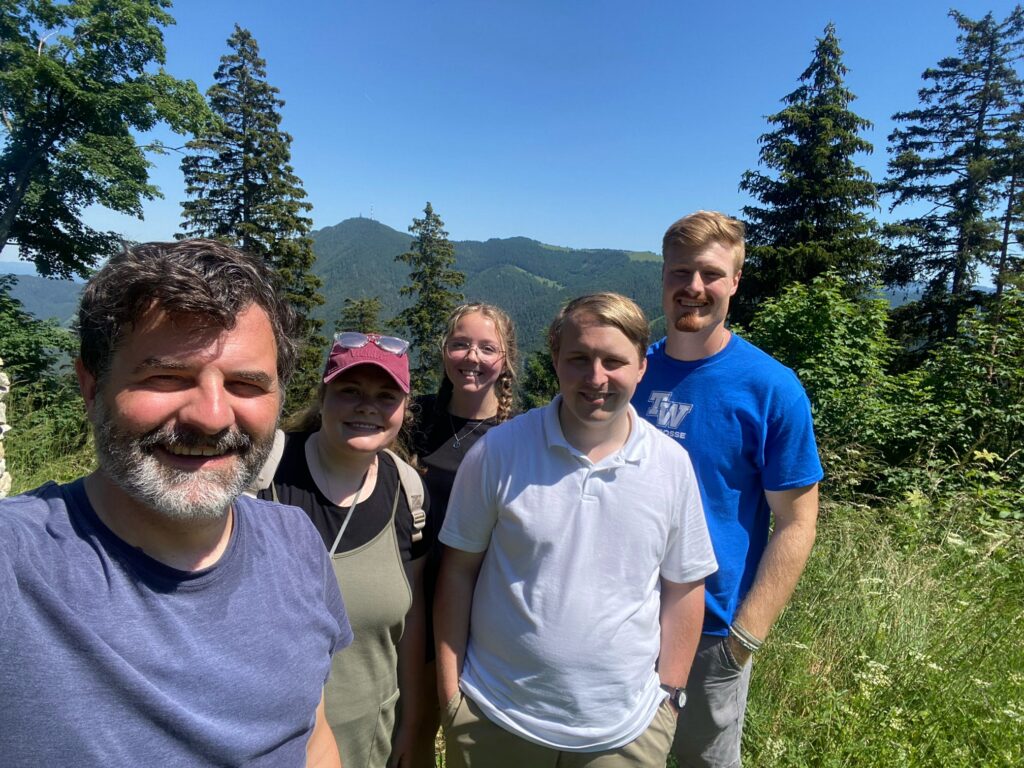
Students also gained practical skills, learning to navigate trains, buses, and trams in three countries, to solve problems as a team, and to adapt when plans changed. For many Tennessee Wesleyan students, many of whom are the first in their families to attend college, the trip was also their first time outside the United States, and for some their first time on an airplane.
The effect on their sense of what is possible was clear. One student wrote, “I like the person I am abroad,” adding that the trip showed her she was far more independent than she had believed. Another said she realized she had been making excuses about why living or working internationally could never happen, and that she now sees it as a goal within reach.
The course is a model of the kind of transformative, liberal arts education that Tennessee Wesleyan University and the TWU Honors Program take pride in offering. Students read demanding scholarship, wrestled with big questions, and then tested their ideas against the places and people that history had shaped, learning not only what happened but how to think, ask questions, and engage with people whose experiences differ from their own. Research on high-impact educational practices has long identified study abroad as among the experiences most likely to produce deep learning, engagement, and personal growth.
Dr. Seitz added, “Study abroad embodies the very heart of a liberal arts education. For more than 150 years, Tennessee Wesleyan has emphasized the importance of developing thoughtful, curious, and engaged citizens who understand the world beyond their own experiences. These opportunities take that mission beyond the classroom, allowing students to encounter history, culture, and new perspectives firsthand while learning alongside faculty who are invested in their growth as whole humans. There is something transformative about standing in the places you have studied, engaging with the people and cultures that bring history to life, and seeing familiar ideas through an entirely new lens. That combination of academic discovery, personal growth, and meaningful human connection is what a Tennessee Wesleyan education has always been about. Study abroad isn’t simply an extension of the classroom; it is a reflection of who we are and the kind of education we are committed to providing.”