
Mathematics
November 25, 2023 2026-11-03 16:31


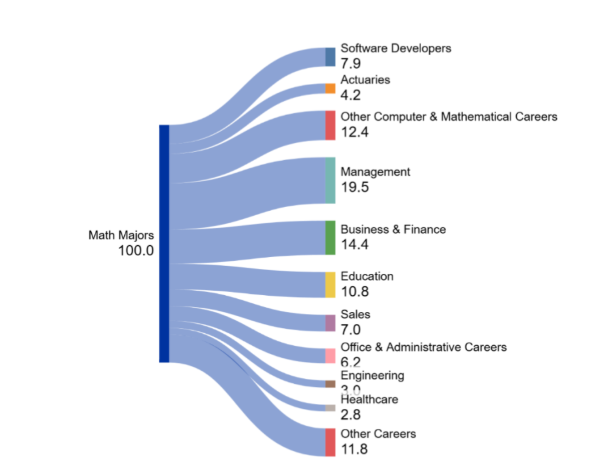
Possible Careers for Math Majors
1.) Data Analytics and Data Science
These professionals use data to identify patterns, test ideas, forecast outcomes, and support decisions in business, government, healthcare, technology, and research.
2.) Quantitative Finance
Quantitative finance applies probability, statistics, optimization, and programming to pricing, investment, credit, and financial risk.
3.) Operations Research and Decision Analytics
Operations research analysts build models that help organizations allocate resources, schedule work, improve logistics, and compare competing decisions.
4.) Actuary
Actuaries measure financial risk and uncertainty, especially in insurance, benefits, pensions, and enterprise risk management.
5.) Statistics and Research Analysis
Statistical work includes designing studies, analyzing evidence, measuring uncertainty, and explaining what data can and cannot support.
6.) Machine Learning and Artificial Intelligence
Machine learning teams develop, test, and deploy models that learn from data. The work combines mathematics with software engineering and careful evaluation.
7.) Cybersecurity and Cryptography
Cybersecurity professionals protect systems and data, while cryptographers design and analyze mathematical methods for secure communication.
8.) Applied Mathematics and Research
Applied mathematicians build models and computational methods for problems in science, engineering, government, and industry. Pure mathematics research develops new theory and proofs.
9.) Mathematics Education and Teaching
Mathematics teachers help students understand concepts, develop problem solving skills, and explain their reasoning. Tutoring and Math Lab work offer opportunities to practice these skills during college.
10.) Graduate School and Research
Graduate study is a preparation pathway for careers in mathematics, applied mathematics, statistics, data science, and related research fields. Students deepen their knowledge and learn to investigate questions whose answers are not yet known.
Why Choose a Math Major
1.) Math is flexible.
Math majors work in many different (often high paying) fields.
2.) Math majors will be in demand as AI booms.
The rise of AI has fueled a greater need for people that can understand the complexities of an evolving and ever-changing job market. Those that can “look under the hood” are in more demand than ever.
3.) A math degree is an investment.
The median starting salary for a math major is $62,000, while the median salary for someone 5 years into the field is $88,000.
Which Major Degree is the Perfect Fit for You?
Mathematics B.A. or B.S.
Progress from calculus to advanced mathematics, including abstract algebra and analysis. Study statistics, programming, linear algebra, differential equations, and numerical analysis along the way. The major includes University Physics I with a laboratory and an upper-level mathematics elective, and culminates in a mathematics seminar and independent senior paper.
The mathematics major requires 55 credit hours. The BA also includes intermediate-level proficiency in a foreign language. Work with your advisor to choose electives and related coursework that fit your goals.
Mathematics Education for Grades 6 to 12
Combine mathematical knowledge with preparation to teach it. This pathway includes a 42-credit mathematics core, including geometry and history of mathematics, together with professional education coursework, field experiences, a practicum, and 12 credits of student teaching.
Study teaching methods, classroom management, assessment, instructional technology, and the needs of diverse learners. Plan early with mathematics and education advisors to meet Teacher Education Program admission, student teaching, and licensure requirements. Graduation requires at least 120 total credit hours.